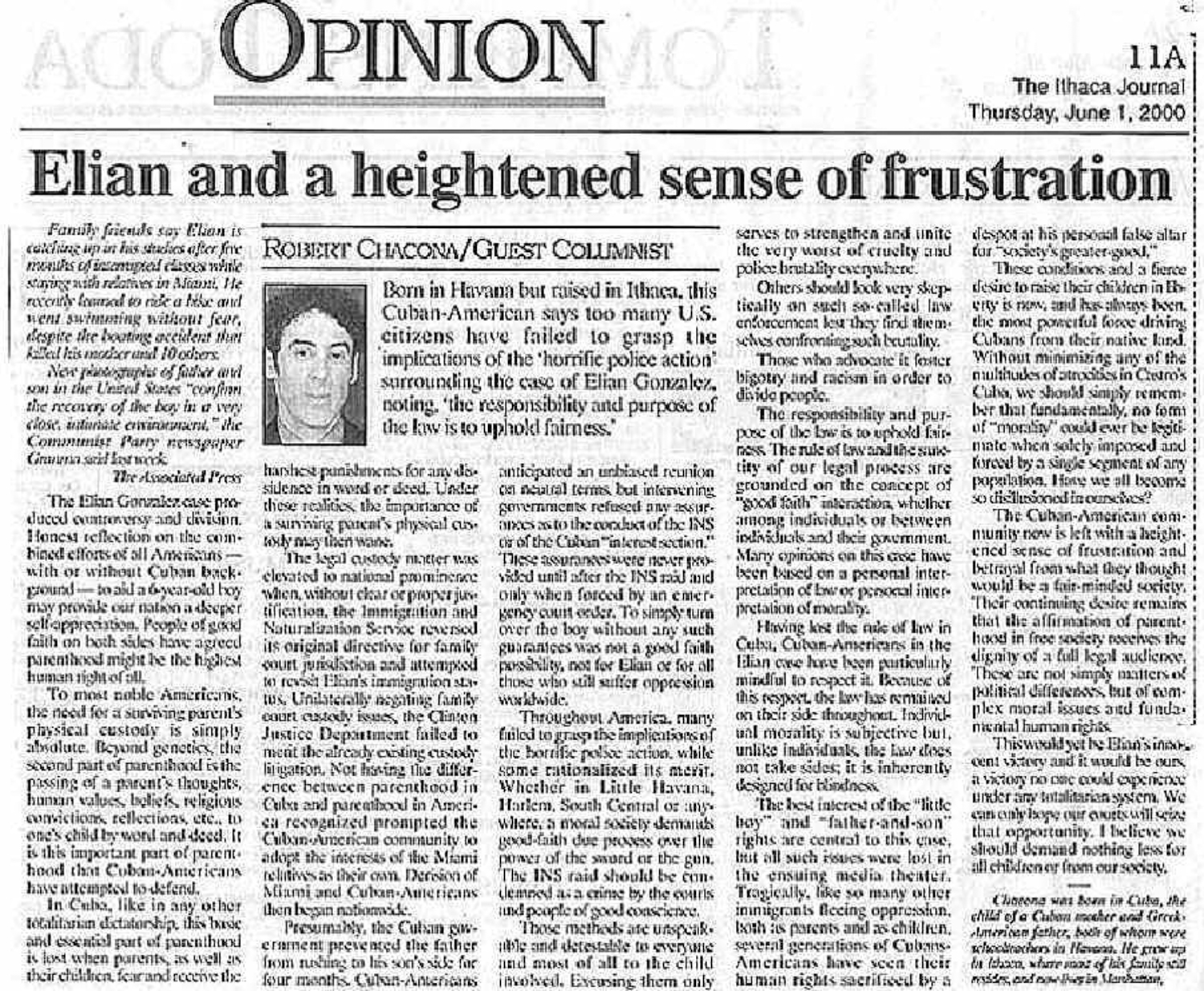
Appeared: Ithaca Journal – 06/01/00
Author: Dr. R. L. Chacona – “Guest Columnist”
Submitted As: An Innocent Victory
Keywords: Elian, Cuba, Human Rights.
¿QUIENÉS SON? Y ¿POR QUÉ ESTÁN AQUÍ! ( WHO ARE THEY? AND WHY ARE THEY HERE?! )
An Innocent Victory?
Why did the Elian case produce such controversy and division?
Honest reflection on the combined sentiments of so many Americans to support this young six-year-old may yet provide our nation a deeper self-appreciation. Much has been argued, yet with earnest conviction both sides always agreed parenthood is one of the highest human rights of all. To most Americans, the need for a surviving parent’s physical custody seems paramount and absolute. Beyond genetics, parenthood could be defined as the passing of parental, thoughts, human values, beliefs, religious convictions, reflections, etc., to one’s child by word and deed. Cuban-Americans are far too aware that such choices are not available to parents in Cuba. In spite of the naiveté of far too many people, the reality in Cuba, is that anyone disagreeing with the government, even verbally, publicly or privately, risks extended imprisonment, torture or even death. Cuba’s wonderful 1940-Constitution remains suspended throughout Fidel Castro’s reign. Without legal rights themselves, parents, as well as their children, both fear and receive the harshest reprisals for the slightest dissidence in word or deed. All mothers and all fathers have been forced to give up the virtues of family and of parenthood to the total control of that police state. The freedoms of parenthood or of citizenship that most Americans happily consider so absolute do not exist for Cuban parents or for any Cuban.
Elian’s legal child-custody was elevated to national prominence when, without any proper justification, the Immigration and Naturalization Service reversed its clear, original directive for family court jurisdiction and insisted instead, to revisit the child’s immigration “status”. Unilaterally negating any standards in a custody process, the Clinton Justice Department failed to merit the relevant issues of the previously ongoing custody litigation. Cleverly dismissing any specifics of all significant legal-custody arguments, the differences between parenthood in Cuba and parenthood in America would not be brought to light. Not having any of these differences even recognized, prompted the Cuban-American community to then adopt the interests of the Miami relatives as their own. On television and in print, immediate derision of Miami, Little Havana and Cuban-Americans was perfidiously well-orchestrated nationwide.
Presumably, the Castro government prevented a doting father, from rushing to his rescued son’s side for over four-months. Later, most Cuban-Americans anticipated an unbiased reunion on “neutral terms” but intervening governments refused even temporary assurances for avoiding immediate extradition of Elian by the US-INS or by the arriving armed Cuban “interest section”. These assurances were never acknowledged until after the INS raid and only when imposed by an “emergency federal-court order” preventing Elian’s unhindered removal to Cuba. To simply turn over the boy without any such prior guarantees was not a good faith possibility; not for Elian or for anyone, anywhere, who still suffers under government oppression.
In Castro’s cruelly effective totalitarian dictatorship, all children ‘belong’ to the Cuban state. No children, of any age, are allowed “parenthood.” Children are taught a duty to denounce even their own parents and families, to the “State.” Castro’s education system imposes its brainwashing of children early, to stamp out much of the individual thought that true parenthood might provide. Under these, and many other human abuses, the concept of supremacy for a surviving parent’s “physical custody” can not be as easily affirmed. Cuban-Americans elected to challenge the sanctity of “parental” custody through limitations of child and adult human-rights abuses. Ironically, by contesting a paternal custody, in this case, it is actually “individual parenthood” and the concept of a “nuclear family-unit”, as cherished elements of a society, that Cuban-Americans wished to revere and to defend.
Legally, note the opinion, April 19th, 2000, of the Federal Court of Appeals of the 11th Circuit (A pdf-file). The Justice Department’s specific request for validation of the INS’s previous “turnover” order was completely ignored by the court. The court’s opinion also further repudiated any question of the Miami relatives’, Justice Department-alleged, “breach of law”. The Federal Court cast serious doubt on any INS jurisdiction and on the Justice Department/INS’s actual “turnover” order itself. The court’s language favored a return to the custody hearing and very clearly requested “mediation” on the specifics of Elian’s interim possession. Less than forty hours after this 11th Circuit Court’s statement was made public, the Justice Department and the INS trashed the court’s opinion, raiding the private home of American citizens with a falsely acquired warrant and without regard for the, then occurring, good-faith mediation requested by the federal court. Our government essentially precluded any forthright litigation or for that matter, the fair rule of law.
The responsibility and purpose of law is to uphold fairness. The rule of law and the sanctity of our legal process is grounded on the concept of “good faith” interaction, whether among individuals or between individuals and their government. Having lost the rule of law in Cuba, Cuban-Americans, in the Elian case, were particularly mindful to respect it. Because of this respect, any honest review of the sequence and events will show that the law remained on their side throughout. So desperate to snatch victory, the federal government’s position and raid was morally and legally indefensible to any truly unbiased assessment. The INS’s actions should be severely condemned as a crime, by our courts and by all people of good conscience. Those methods are unspeakable and detestable to everyone and most of all to the child involved. Many opinions on this case have been based on a personal interpretation of law or personal interpretation of morality. Individual morality on the issues is subjective but, unlike individuals, the law should not take sides and is inherently designed towards blindness.
Throughout America, many failed to grasp the implications of the dreadful police action, many sophistically rationalizing its merit. With the raid, our federal government disgraced our constitution and our country before the world. Whether in Little Havana, Harlem, South Central or anywhere, a moral society demands good faith due-process over the power of the sword or the gun. Excusing such actions, only serves to strengthen and unite the very worst of cruelty and police-brutality everywhere. Others should look very skeptically on such so-called “law enforcement” lest they find themselves confronting such brutality again on some other future issue. All those who advocate such acts foster bigotry and racism in order to divide people.
Like so many other immigrants fleeing oppression, both as parents and as children, several generations of Cubans-Americans have seen all of our own, prized human rights sacrificed by a despot at his false personal altar for “national security”, “a new moral man”, and “society’s greater-good.” Without minimizing any of the multitudes of atrocities in Castro’s Cuba, we can acknowledge that, fundamentally, no government or form of “morality” can ever be legitimized when brutally forced and solely imposed by a single segment of any population.
The best interest of this one “little boy” and a right to be with his father, though very central to this case, were not the only issues. All other vital issues about parents’ and children’s rights in Castro’s Cuba were lamentably buried in perpetual media theater. A chance for their children to live in “liberty” is the primary reason why so many Cuban-Americans fled their native land and have come the United States. Have we all become so disillusioned in ourselves and in our society not to recognize the importance of their genuine viewpoint? The Cuban-American community is now left with a heightened sense of frustration and betrayal from, what they thought was a more fair-minded society. Their continuing desire remains that the affirmation of human rights and of true parenthood in a free society yet receive the mere dignity of a fair legal audience.
These are not simply matters of economics or of political differences, but complex moral issues of fundamental human rights; human rights of all children as well as of all parents. We can only hope our courts hearing good faith arguments for Elian’s asylum will yet seize an opportunity to bring these issues into clearer focus. Elian and all children have many human rights; they all need to be respected. Whatever the outcome for Elian, a fair legal-audience is something that, tragically, no one can ever experience in today’s Cuba or under any totalitarian government. I believe we should demand nothing less for all children or from all civilized society.
This would yet be Elian’s innocent victory and it would also be ours.
Dr. R. L. Chacona – N.Y., NY
“I was so much older then, I’m younger than that now.” Bob Dylan